
Impact of Atmospheric Stability on Wind Farms Efficiency in the North Sea
By: Sebastiano Stipa, Alexandros Palatos-Plexidas and Wim Munters

Large offshore wind farms do more than generate renewable energy. They also interact with the atmosphere in ways that can influence their own performance. Researchers at the von Karman Institute for Fluid Dynamics investigated how atmospheric stability and atmospheric gravity waves affect the efficiency of large offshore wind farm clusters in the North Sea.
Using large-scale numerical simulations performed on VSC infrastructure, the team quantified these effects under realistic atmospheric conditions and over a statistically representative period of one year.
Understanding the Interaction Between Wind Farms and the Atmosphere
As offshore wind farms extract energy from the wind, they create large wakes downstream of the turbines. These extensive wind farm clusters act as large obstacles in the atmosphere, forcing air to move around and above them.
"Below rated power, gravity-wave feedback effects increased annual wind farm cluster efficiency by up to 4.5% in the world's largest offshore wind farm cluster."
When air parcels are displaced upward into the stable atmosphere above the turbulent boundary layer, gravity acts to restore them to their original position. This creates oscillatory motions known as atmospheric gravity waves.
These gravity waves can alter pressure and wind speed patterns around wind farms. Higher pressure often develops upstream of a wind farm, reducing incoming wind speeds and available power. At the same time, favorable pressure gradients may form within the farm, helping slower wake flows recover more quickly.
The overall impact depends on atmospheric conditions, including wind speed, temperature stratification, and wind farm layout.
Simulating One Year of Atmospheric Conditions
While previous studies examined atmospheric stability and gravity waves under idealized conditions, little was known about their impact over long periods and under realistic weather conditions.
To address this, researchers at the von Karman Institute for Fluid Dynamics performed computationally intensive mesoscale weather simulations covering an entire year of atmospheric flow over the North Sea.
The simulations were conducted twice: once including wind turbines and once without turbines. The turbine-free simulations provided non-perturbed atmospheric conditions at turbine locations, which were then used as input for a fast-running engineering model capable of isolating the effects of atmospheric stability and gravity waves.
The simulations including turbines enabled the researchers to study the physics of gravity waves under realistic atmospheric conditions and develop a methodology for detecting these phenomena, potentially supporting future observations in real-world wind farms.
Key Findings
Atmospheric gravity waves have a measurable impact on offshore wind farm efficiency, influencing the pressure and wind conditions experienced by turbines.
Below rated conditions, efficiency gains of up to 4.5% were observed in the Belgian-Dutch offshore wind farm cluster — currently the largest offshore wind farm cluster in the world — while Dutch and UK clusters showed gains of around 3%.
The dominant physical mechanisms depend on the wind farm layout: wind speed variations are most important for large, dense clusters, whereas wake redirection effects due to gravity waves play a greater role in smaller, more dispersed clusters.
The most favorable atmospheric conditions occur mainly at lower wind speeds, meaning their impact on total annual energy production is more limited.
A new classification framework was developed to identify atmospheric conditions where gravity-wave effects are strongest.
Future work will validate these findings using real-world observations, including synthetic aperture radar (SAR) and supervisory control and data acquisition (SCADA) data.
The Role of VSC
The methodology developed in this research relies on computationally intensive numerical simulations of a large portion of the Earth's atmosphere.
"One year of North Sea atmospheric simulations powered by the VSC Tier-1 Hortense supercomputer."
These simulations required state-of-the-art numerical weather models running on the VSC Tier-1 Hortense supercomputer. VSC provided the computational resources necessary to simulate a full year of atmospheric conditions across the North Sea.
Access to this high-performance computing infrastructure enabled the researchers to investigate the complex interaction between atmospheric gravity waves and offshore wind farm clusters under realistic and statistically representative conditions, providing new insights into factors that influence wind farm efficiency.
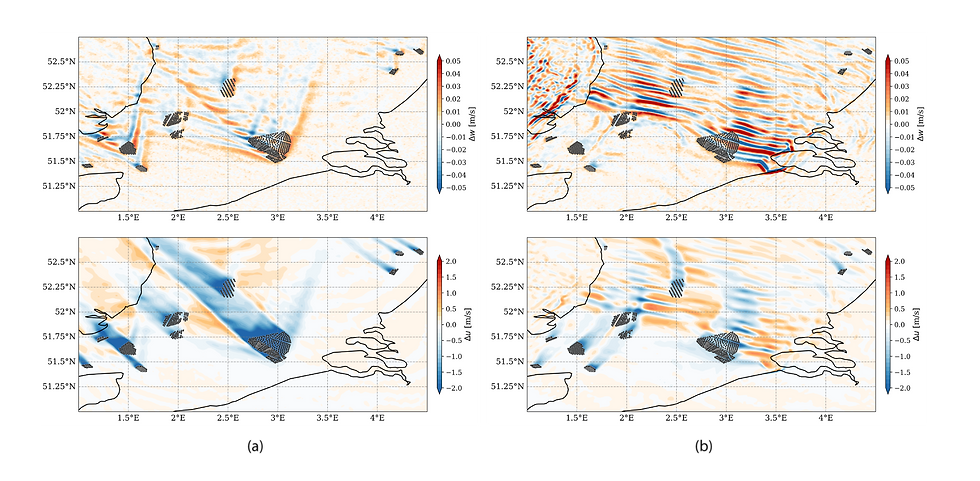
This Research Showcase presents a tailored overview prepared by the authors based on their original publication, “Annual impact of atmosphere stability on the southern North Sea clusters: from gravity wave detection to quantification using a reduced-order model,” published in IOP Publishing. Read the original publication here

🔍 Your Research Matters — Let’s Share It!
Have you used VSC’s computing power in your research? Did our infrastructure support your simulations, data analysis, or workflow?
We’d love to hear about it!
Take part in our #ShareYourSuccess campaign and show how VSC helped move your research forward. Whether it’s a publication, a project highlight, or a visual from your work, your story can inspire others.
🖥️ Be featured on our website and social media. Show the impact of your work. Help grow our research community
📬 Submit your story: https://www.vscentrum.be/sys


