
From Training to Innovation: How VSC Supports Learning & Development
VSC Connect Blog
Interview with Geert Jan Bex, VSC staff member
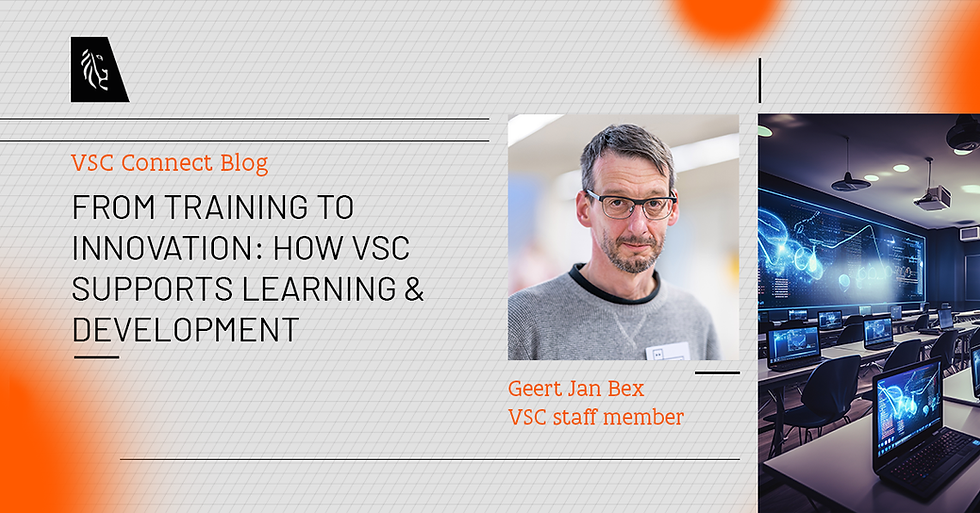
The Vlaams Supercomputer Centrum (VSC) has an extensive training program, so clearly, it is a topic that merits some discussion. Who better to have a conversation with than Geert Jan Bex, the contact person for training at the VSC.
Q: Geert Jan, can you briefly introduce yourself?
Geert Jan: Sure. I joined the VSC in 2009, the year after it was established as an inter-university initiative for supercomputing in Flanders. My background is in physics and computer science, and I’ve always been fascinated by scientific computing. My role is user support, so helping researchers from academics, the public, and the private sectors to use this infrastructure effectively and efficiently. As time went on, I spent more time developing new training materials and fine-tuning the VSC’s training strategies. Currently, I lead the VSC’s training work package on training, and I’m the deputy training work package leader for EuroCC@Belgium, the National Competence Center for High-Performance Computing (HPC), High-Performance Data Analytics (HPDA), Artificial Intelligence (AI), and Quantum Computing (QC).
Q: Since you mention that you gradually spent more time on extending a training program for the VSC, this was likely based on observing needs while supporting users of the infrastructure.
Geert Jan: Indeed, when talking to researchers, you notice that some questions and issues pop up time and time again. Documentation goes some way to address this, but training sessions are more effective. So, you extend an existing training session, or you create a new one, and before you know it, you end up with an extensive list of training sessions. The support staff identifies opportunities and collaborates to create appropriate training material.
Q: So, although you act as a contact person, you don’t do all the work?
Geert Jan: Fortunately not; there are quite a few VSC colleagues involved in its training effort. Each VSC Hub organizes its own Linux and HPC introduction sessions, for instance. Besides spreading the workload, this also allows the users of those systems to get to know the local support staff, and that lowers the barrier to asking for advice and support. Besides these introductions, some staff members also developed and gave sessions that are at an intermediate level, typically more advanced use of Linux and Linux tools, or on how to build software for HPC systems. Recently, the Tier-1 Data team has rolled out a training program specifically for this important service. For domain-specific or very specialized topics, we also invite applications or HPC specialists from other organizations. In the past, PRACE was an immense help in that respect, a role that has now been taken up by the EuroCC project.
Q: This is the second time during this conversation that you mentioned EuroCC. Many are familiar with the initiative, but it is nevertheless useful to explain briefly what it is and what its role in training is?
Geert Jan: A few years ago, the European Union realized that it had to catch up with the United States, China, and Japan on supercomputing. It also realized it could not remain dependent on technology that was sourced from these countries. The EuroHPC Joined Undertaking (EuroHPC JU) was established to remedy the situation. At heart, the aim is to create a European ecosystem for HPC, AI, and QC. Europe should be able to build its supercomputing infrastructure from scratch, hence the European Processor Initiative, but European researchers, the public, and the private sector should also have access to state-of-the-art infrastructure, hence per-exascale systems such as LUMI in Finland, Leonardo in Italy, and the exascale system JUPITER in Germany. However, hardware and services are only one aspect of such an ecosystem. It is vital that those systems can be used to foster innovation, and that requires a vibrant community of users and experts, and hence also a training program. This is the responsibility of the EuroCC project, a network of National Competence Centers (NCCs) in all EuroHPC partner states that collaborate internationally to build that ecosystem.

Q: That means that EuroCC@Belgium can rely on the expertise of other national competence centers?
Geert Jan: Correct, we can and do refer our local community to training sessions organized by other NCCs. Moreover, we collaborate with other NCCs when we identify gaps in the training offerings to develop new training resources. This is a significant help since developing training materials is very time-consuming. In the second phase of the EuroCC project, EuroCC2, the Centers of Excellence (CoEs) also participate actively, and we can also refer our users to their typically very specialized training, for example, the code optimization workshops organized by the POP CoE. Needless to say, collaboration extends beyond training to other domains as well, but that would lead us too far.
Q: Indeed, we would better leave that as a subject for another interview on the broader subject of international collaboration on supercomputing. You mentioned that you joined the VSC about 15 years ago, so there has likely been quite an evolution concerning training. Can you elaborate a bit?
Geert Jan: Back then, we already had introductions to Linux and HPC, as well as a basic introduction to parallel programming with MPI (Message Passing Interface), a communication library for parallel programming. I was planning to expand this when I came across a train-the-trainer course organized by Dr. Rolf Rabenseifner of the HLRS in Germany. You could enroll as a regular participant or as a trainee trainer if you had prior experience in parallel programming. If you complete the training successfully, you can use Rolf’s excellent training materials to do your training sessions on parallel programming with MPI and OpenMP. So, from 2013 onwards, the VSC has organized these training sessions once a year. This was a major step for us, and once or twice a year, we still get an update of Rolf’s materials, which he maintains and expands, although he is officially retired.
Later, other training sessions were added on scientific programming in C, C++, Fortran, Python, and Julia, GPU programming, machine learning, and AI, but that train-the-trainer program was without any doubt a catalyst for all this.
Q: Clearly, that is quite an investment, so why is training so important according to you?
Geert Jan: The main reason is that if our researchers are familiar with best practices on HPC systems, they can also concentrate on their research questions, rather than having to spend time digging through documentation or seeing jobs fail, losing precious time. This allows them to do cutting-edge research and innovate their field or product.
A second answer is that HPC infrastructure is extremely expensive to buy and maintain, and that is taxpayers’ money, so it is our responsibility to ensure that it is used as efficiently as possible. Hence, we try to train our users to do so.
Another answer is that it is claimed that you only really understand a topic if you can explain it properly. Developing training materials consolidates and deepens knowledge. Since you additionally must keep the material up to date, you are also forced to follow up on recent developments. This, in turn helps you to support users more effectively and give them better advice.

Q: A last question: How do you view the evolution of training given AI tools? Will you need to train researchers when they can just ask ChatGPT?
Geert Jan: Funny you should ask; one of our most recent training initiatives is a webinar series on using AI tools for software development and HPC. The bottom line is that, at least for now, a thorough understanding of the subject is still required. Large Language Models (LLMs) simply predict sequences of words and tend to hallucinate, especially on topics they had little training data on. There is not so much material on HPC available on the web, so..I’d argue that the need for proper training isn’t going to disappear any time soon.
Q: Thanks for sharing your insights into this topic. It was nice talking to you.
Geert Jan: Thank you, I am always happy to talk about a subject that fascinates me.


